Showing posts with label punch and judy. Show all posts

11 December 2011

How I Got Into Puppetry

"How does a puppet come into being?  It happens when someone sees an image of himself, or some aspect of the world, in the crooked glass of his imagination and gives it form, movement, and sound. Someone has the urge to bring his drawing to life and make it move and talk.  Or maybe he thinks of a sound first and gives it shape and movement.  Or it may be an intangible, like the force of the wind, that inspires him and he gives it a shape and character.  The primitive urge still applies." - Bil Baird, The Art of the Puppet

Yeti puppet by Krista Dalby
Bil Baird's attempt to explain how a puppet comes into being could just as easily be a response to how a puppeteer comes into being. "How did you get into puppetry?" is a question I'm often asked. I usually give a short answer, one that is not very truthful but is efficient for cocktail parties or classroom conversations. I say that I tried out regular theatre and found it boring. It's not much of an answer. What follows is the rather long but far more accurate response.


From my Dad: "This is Krista's first puppet performance - she was about 4 years old - I  brought kit called DUSO (Developing Understanding of Self and Others) home from grad school [he was studying Psychologyand the world has never been the same."

Like  many other North American kids in the 1970s, I grew up with the Muppets, who were as famous at that time as any other celebrity.  When I watched Sesame Street or The Muppet Show I completely bought in to the fantasy,  rarely considering that the characters were puppets, objects being manipulated by humans. These oddballs clearly had an influence on me, as I named my first pets after them; a trio of goldfish I called Ernie, Bert and Big Bird (epic misnomer).


I grew up in Calgary, and in high school our drama class took a field trip to Lunchbox Theatre, where we saw marionettist Ronnie Burkett perform one of his first shows, Virtue Falls; I've seen many of his other shows in the 20 years since.  I loved drama class, but hated high school, so I dropped out.


Punch and Judy puppets by Krista Dalby

A few years later, I found myself in the theatre program at Mount Royal College, where I took classes in costume- and set-making, stage management, and a variety of others on the technical side of things.  For an assignment in our props class, my class partner and I built an evil wasp marionette; it was pretty well-made, from what I can recall.  
I graduated from college and decided that I never wanted to do theatre again, and proceeded to spend a whole bunch of years working dead-end jobs, traveling, and partying.  I wasn't doing a whole lot creatively, but I was writing.


Even sock puppets like to get their drink on.

Eventually I went to Concordia University in Montreal and got a degree in Creative Writing.  I wanted to be a novelist.  No, a short story writer.  No, for real this time, a screenwriter.  Or maybe a tv writer? Who was I kidding?  Resistance was futile.  The theatre dragged me back and I started writing plays.  Most of them were pretty terrible, but then they started getting better.


After university I moved to Toronto, where I got a Real Job and paid off my student loans. One day I heard that artist Lisa Pijuan-Nomura was holding a puppetry workshop. I had no idea what to expect but soon discovered her beautiful vision: a flock of puppeteers would create small portable puppet shows in cardboard box theaters. During one of the famously fun Red Cabarets, we would simultaneously descend on individual tables and perform short puppet shows. I had never heard of anything like it but I'm adventurous and I was eager to give it a try. My show was about two formerly conjoined twins; one was about to depart for space camp and the other was having severe separation anxiety. The performances began and the cacophony was unbelievable, the delighted surprise of the audience and the energy of the puppeteers were a potent mix. I'd never considered myself much of a performer, but when I performed my puppet show, I was delighted to discover that it wasn't about me at all. My audience was watching these two freaky little dolls being moved around in a cardboard box. And they were riveted.

This was awesome.


The possessed look on my face says it all.

That was the night I fell in love with puppetry.


Milé reads a book to Little Milé (puppet by Krista Dalby)

Some time before this I had fallen in love with a man.  
 Two years later, Milé and I moved in together.   He was living in a tiny third floor apartment (which we called The Shoeboxin Toronto's West end, and the day I moved in with him I met his downstairs neighbor, David Anderson.  I knew that David was a theatre person, so I suggested that we have dinner and get to know each other.  Our dinner date rolled around, and when Milé and I showed up, David was totally distraught; his producer had just quit, and he had a show opening in just a few weeks.  As it so happened, I had just left my Real Job and had no immediate prospects, perhaps I could help him out for a few weeks?  I was hired over dinner that night, and wound up working with David at Clay & Paper Theatre for the next four years.
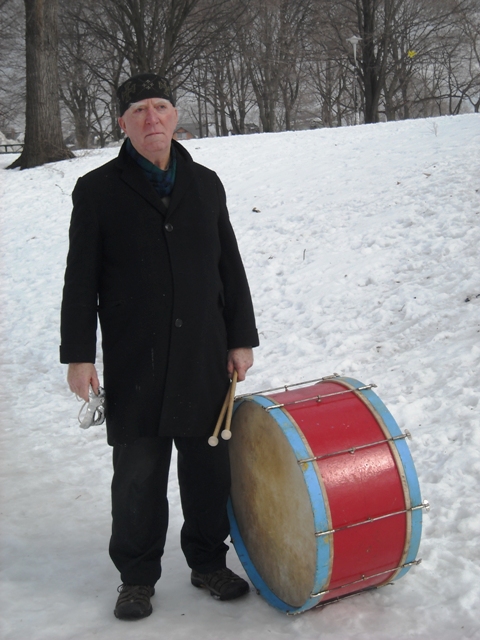

David Anderson of Clay & Paper Theatre

Clay & Paper creates outdoor theatre, parades and festivals using a myriad of puppetry styles, from giant puppets to hand puppets, and everything in between.  David and I wrote four plays together (soon to be five!), and I produced all of the company's shows and events from 2006 to 2010.  This was where my true education in puppetry took place.  David had been creating public space performances since the sixties, and there was no idea that was too crazy.  Turn a wheelbarrow into a puppet herd of race horses?  No problem.  Form a bicycling-oriented puppet squad?  Sounds perfectly reasonable.  Burn twenty-foot skeleton sculptures in the park?  Terrific!  I wrote, I produced, I built, I performed, I led workshops, and over the years organized hundreds of people.


That's me walking my dead frog in a baby carriage,
representing The Fear of Species Extinction,
At Clay & Paper's annual Night of Dread

Thus it was that puppetry conspired to take hold of me.  Meanwhile I had met young performer and producer Guy Doucette, who invited me to attend one of his shadow puppetry plays.  I was instantly fascinated by the art form. Guy and I became fast friends and soon we were collaborating on shadow plays.  I also met teacher Craig Morrison through Clay & Paper; he's a kick-ass designer, and soon he started collaborating with us, too. Over the last four years we've created half a dozen shadow puppetry plays, which have become increasingly complex and refined.


Shadow puppets from The History of Shadows,
designed by Craig Morrison and Guy Doucette

When I made a brief foray into the world of opera with Tapestry New Opera Works, of course my puppet-brain came with me, and I wrote two operas for puppets: The Shaman's Tale (composer Kevin Morse) with giant puppets and shadow puppets, and sock puppet opera The Perfect Match
 (composer Anthony Young) which was eventually made into a Bravo! short film.


Scene from The Perfect Match

I can't seem to quell this madness for puppets, and now spend a good deal of time doing puppetry workshops through ArtsCan Circle, the Ontario Arts Coucil's Artists in Education program, and at Small Pond Arts.

So there's the long answer to how I got into puppetry.  Or perhaps, how puppets got into me?

Scary Clown says "BYE BYE!"
Puppet by Krista Dalby

28 July 2011

Cornography

From the first time I stepped foot on the land that we now call Small Pond Arts, I saw a show happening here. 

We visited the property for the first time in the fall of 2009 while searching for the perfect place for our dream to take hold.  As we walked the paths in the woods, I saw not only myself here, but I saw future artists and audiences here.  The shape and layout of the property would be perfect for a site-specific travelling performance.  On July 24, 2011, this dream was finally realized with Cornography.  My vision was for an afternoon of art about food, where audiences would be led from location to location to discover theatre, music, puppetry, installation and visual art. 

Illustration by Milé Murtanovski

I put out a call for submissions inviting artists of any discipline to respond to the theme of “our twisted relationship with food.”  I have always been a lover of food, and the subject has been much on my mind since moving to the agricultural area of Prince Edward County.  I’ve watched too many documentaries and read too many books about our modern food system, which is so deeply dysfunctional and fragile.  Since we moved here we have grown closer to the food system; within our first year at Small Pond we started growing some of our own food, and after becoming friends with some local farmers we've gained a greater appreciation for the work that they do.  There is so much to say on the subject of food that I wasn’t too surprised when almost 40 artists responded to the call with a dazzling variety of takes on the theme.  As the months went by, the pieces of Cornography fell into place one by one, and the shape of the day took form.

A small portion of the bounty coming from the Small Pond garden
Out-of-town artists started arriving a few days before the show and Small Pond was once again a veritable hive of activity, with elaborate installations being built, rehearsals taking place, artwork being delivered, and much mowing of paths and performance areas.  Then there were the preparations for the meal; if we were going to have 40 artists doing a show about food, we obviously had to feed them, and we had to do it in style.  We planned for the day to conclude in The Great Artists’ Feast, a dinner party held in their honour.

Mary Macdonald working on her installation to make lasting
You never know how these things are going to turn out.  All you can do is be as prepared as possible and hope for the best.  The day finally arrived and the weather was glorious.  All the artists showed up.   And, rather importantly, so did the audience.  The visual art was displayed in the barn, and the show began with a dozen visual artists introducing themselves and their work.  The audience was then led to a Punch and Judy show performed by myself and Trevor Jablonowski, wherein the notorious puppet Punch falls in love with a cob of corn, much to Judy’s misfortune. The audience actually booed at one point – what a great compliment!

Punch and the Corn Cob
Everyone loves a puppet love triangle
Two artists from Florida, Rachael Kerley and Giang Pham, had arrived a few days previous on a week-long artist residency. Their sensual, interactive installation Sacrament, Wash, Passage, Altar took place in the ‘salon du silo,’ the garden area that surrounds the silo.  It was a meditation on the grains of eastern and western cultures: corn and rice.  At Sacrament people were given small bags of pop corn and Rice Krispie squares to munch on; at the Wash station they were offered (and often accepted) a corn oil and rice foot rub; in Passage they walked on a path of rice and corn; and at Altar they were met with an array of glass jars containing oil, water and grains.
Sacrament
Wash
Passage
Altar
Our good friends Bay Woodyard and Gavin North of Honey Pie Hives and Herbals performed a puppet-filled Travelling Medicine Show.

The Traveling Medicine Show
Children were led away to the Art Barn to make corn-husk dolls with Cynthia Dinsdale, and the DitchWitch Brigade from Toronto (Eve Wylden, Antje Budde & friends) presented an excerpt of their play called Miss Toronto Gets a Life in Parkdale.

Children of the corn
Eve Wylden in Miss Toronto Gets a Life in Parkdale
Local songstress Melissa Larkin performed next, filling the art barn with the sound of her tantalizing music and spoken word.  The audience was then led to the spot behind our house, where Guy Doucette, Pat Larkin and Koren Bellman performed a musical puppet piece called Doctor Frankornstein and the Stalking Terror.

Melissa Larkin
Dr. Frankornstein and the Stalking Terror
In the back field our audience met Mary Macdonald and her installation to make lasting.  Mary had been at Small Pond every day that week, mostly perched atop a ladder in our back field as she built a large cage of buckthorn branches.  During Cornography people were invited to write their favourite foods on recipe cards which were hung from the structure. 

Close-up of to make lasting by Mary Macdonald
I had invited local visual artist Chrissy Poitras of Sparkbox Studio to participate in Cornography, and was surprised and delighted when she told me she wanted to do a piece of performance art.  For the performance we laid down a long runway of white felt in the middle of a tall field of grass.  People were asked to take off their shoes and walk down the carpet to where Chrissy was waiting for them, wearing a white dress and blindfold.  She then proceeded to eat a pomegranate as messily as she could.  The audience fell completely silent, mesmerized by the scenario; a little bit of magic taking place under the big blue sky.

Chrissy Poitras just prior to her performance
Jeff Keary gave a lecture on the subject of salt and its insidious nature.  Then Katy McIntyre led a piece we called Cornfield of Dreams.  She passed out pens and paper corn cobs to people and asked them to finish the sentence “My dream of the future of food is…”  Once they’d written their dream, they held them aloft and were led in a procession through the woods, passing young fiddler Luke Norton.  The woods open out to a huge field where people "planted" their dreams atop stakes. 

The procession of dreams.  Photo by Phil Norton.
Luke Norton fiddles in the woods.
"My dream for the future of food is... a garden for every home."
Our final act of the day was Arlene Bishop, a musician I have admired from afar for years.   Arlene’s music is quite simply spell-binding; lucky for us, she’ll be back at Small Pond August 26, 27 and 28 as the musical guest for our shadow puppetry play The History of Shadows.

Arlene Bishop
The Cornography performances and programming may have been over, but there was still one final act: we had to eat!  Long tables were put end to end in the shade of the Manitoba Maple in the front yard, and an abundant buffet of local food (much of it from our own garden!) was laid out.  The Great Artists’ Feast began, and it was so satisfying to sit back and watch all the artists sitting shoulder to shoulder with one another, breaking bread.  The meal was put together by one of my oldest and dearest friends, Tanis De Sa Pereira and her two teenagers, Spencer and Sydnie.   Not only are they great cooks, but having them play such an integral role in the day just added to the warm feeling of being amidst family.

The Great Artists' Feast
As you can imagine, it was a full, full day – full of energy and imagery and ideas, full of friends and laughter and surprises.  Our community was incredibly receptive to Cornography; clearly we have touched on a subject matter which is vital and relevant to them.  The quality and scope of the art was undoubtedly impressive.  Therefore Milé and I have already decided that we will do it all over again; artists, start simmering your ideas and stay tuned for details about Cornography 2012, coming to Small Pond next July!

Krista and Milé give thanks.
Huge thanks to everyone who participated in Cornography, artists and audience alike.  You have shown us what is possible, and we are forever grateful for all that you brought to the table.

Impromptu dinner table art by Celeste Hill.