Showing posts with label sandra henderson. Show all posts

01 September 2011

Back to the Shadowlands

There have been a few lucky moments in my life as an artist when I've been in the right situation at the right time, surrounded by just the right people to support me, allowing me to work at my full potential.  The last couple of weeks have been such a time, as I worked with an incredibly talented and devoted group of collaborators, bringing two shadow puppetry plays to life:  The History of Shadows and Doubt Seed, which we presented at Small Pond Arts.

Poster by Milé Murtanovski 

We first came up with the idea of The History of Shadows last summer while were developing Doubt Seed (which I wrote about extensively here).  Wouldn’t it be cool to tell the history of shadow puppets – with shadow puppets?  And to take things one step further – what about the history of shadows themselves?  The more I learned about shadow puppetry the more fascinated I became with its long and rich history.  Why do we as theatre-makers choose to work in this obscure, ancient form?  What is it that attracts us to telling stories with a palette of darkness and light?

Designers Guy Doucette and Craig Morrison in the Shadowlands
shad·ow·lands [shad-oh-landz] noun: A rare mental condition in which one is compelled to make shadow puppets for many consecutive hours, losing all sense of space and time. Often includes paralysis of the fingertips, bloodshot eyes, and prolonged delirium.

I started writing the script while Milé and I were in Arizona last winter.  I’ve been writing plays for more than ten years and I am still astonished how some scripts can come so easily, while others can be so difficult.  It took me six months to figure out what was going on in The History of Shadows.  I immersed myself in research, turning up many fascinating historical facts and anecdotes to include, but I struggled to find the emotional content.  Why did this story matter, and how would audiences be able to connect with it on a personal level?  The answer clearly lay with the narrator, Professor von Luminous van Murk.   I met with my collaborators numerous times over the months to try and unlock this puzzle.  Finally, and not a moment too soon, it came to me.  Despite all appearances of being a history lesson, it was ultimately a love story, and a tragedy, and these two elements would colour every aspect of the Professor’s lecture.  I figured it out just in the nick of time, turning out a final draft from which the designers could design and our narrator could learn his lines.

I, too, spent my time in the Shadowlands.  Beer helps.
The History of Shadows takes us on a whirlwind journey around the globe and through time, from the Incas of Machu Picchu to philosopher Plato, the shadow puppet masters of Indonesia, the hated Marquis Etienne de Silhouette, the trendy 18th Century shadow players of Paris’ Caveau du Chat Noir, and many others, demonstrating how the humble, ethereal shadow has shaped our world.

A young Professor Murk travels to Indonesia with Charlotte
Our artist collective is always trying to push the boundaries of our work and try new things.  The design of the show by Craig Morrison and Guy Doucette was nothing short of brilliant.  It was full of complex, layered and encoded imagery, that perhaps is only fully appreciated with a second or third viewing.  It also explores meta-theatrical concepts, such as puppeteers controlling puppets who are puppeteering.

Murk puppeteers Murk and Charlotte
A Balinese shadow puppet comes to life when the eye is cut, therefore it is the last
detail to be added, lest the puppet be witness to its own creation
Being the writer and producer, it seemed like a natural progression for me to add ‘Director’ to my list of duties.  In the past our collective has worked without a director, opting for a very democratic, collaborative creative practice.  But all of us are interested in improving our craft, and the best way to do that is to have a critical eye on the proceedings.  Besides, I realized last year after crawling around on the ground for a week, that I was getting too old to be a shadow puppeteer.  My knees protested.  My back ached.  It was time to move out from behind the screen.

Speaking of screens, our friend David Riley built us a fancy new
shadow screen, which really upped our production values.
Trevor Jablonowski, dear friend and Small Pond regular, did a spectacular job of bringing the Professor to life in his role as narrator.  His performance was by turns riveting, hilarious, and heart-breaking.  When not performing, Trevor also delivers coffee, barefoot.  


The History of Shadows is not exactly a light-hearted puppet show, and I think the audience was relieved when they found themselves watching a more fable-like show in the second half with Doubt Seed.  There are some easy laughs in that play, and Guy Doucette’s energetic performance leaves the night on a high note.

Guy Doucette as Wes in Doubt Seed
We had three magical performances; the first two were outside, where the action was  underscored by a chorus of a thousand crickets, and we used environmental projections to great effect.  The last night of the show we moved indoors to the art barn as the weather was looking a little dicey. 


Our performances were accompanied by brilliant musical guest Arlene Bishop, who also appeared recently at Cornography.  I love it when we have girls with guitars roving about the farm like wandering minstrels.

Puppeteers backstage on opening night
Six months of planning, two weeks of intensive building and rehearsing while all living together at Small Pond, three nights of performances... and in a blink, somehow it was all over.  We were so immersed in the experience of creating the show, were so swept away in the tide of creativity and camaraderie, that it was quite a shock to all of us to have to say an abrupt farewell.  With reluctance the hundreds of puppets were carefully packed away. 


The puppeteers and I all clung to each other, unwilling to let the magic end.  Even now, days later, I miss them all so much.  The sound of the crickets is deafening in the absence of their laughter. In the words of Goethe, and as was quoted in The History of Shadows, “Where there is much light, the shadow is deep.”   My most profound thanks to my collaborators for shining such a bright light in my life.  I can’t wait to do it all over again.

The cast and crew of History of Shadows and Doubt Seed, from left to right:
Front row: Trevor Jablonowski, Craig Morrison, Guy Doucette.
Back row: Krista Dalby, Mo Morrison-Brandeis, sandra henderson, Lauren Hortie.
Thanks to all our helpers - especially Elizabeth Brandeis and Milé Murtanovski - and to the Ontario Arts Council and Canada Council for the Arts for their financial support.

13 September 2010

Playing with Shadows


Some time last year, a seed of an idea started to grow.  From that small idea grew the shadow puppetry play Doubt Seed that we performed a few weeks ago at Small Pond Arts.


Doubt Seed is the fourth shadow puppetry collaboration between me and artists Guy Doucette and Craig Morrison. Our previous shadow plays were Wolf/Flow (a dark retelling of the Little Red Riding Hood), Leap Year Pudding, which involved more than 60 high school students, and Dreams A Go-Go, which we performed at Toronto’s Nuit Blanche and featured projections on a three-story building while puppeteers performed in the windows.

L to R: Mo Morrison-Brandeis, Craig Morrison, Guy Doucette, Sandra Henderson, Krista Dalby
For Doubt Seed we were fortunate enough to be joined by puppeteers Sandra Henderson and Mo Morrison-Brandeis, and benefited from the help of a number of volunteers who pitched in at the 11th hour to make it happen.

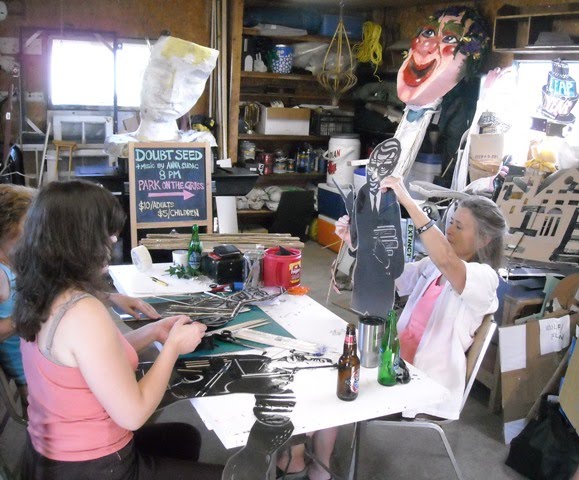
Volunteers hard at work in the puppet sweatshop
Make no mistake: puppetry is serious business. If watching theatre requires a leap of the imagination, then puppetry is the long jump of the theatre world. It is in this leap that the magic of puppetry occurs, where our hearts can be broken by the careful manipulation of sticks or fabric, where we can cheer for a heroic piece of cardboard, and where we can speak truthfully about things we couldn’t say otherwise.

Craig does some early morning puppet-cutting by the firepit
Shadow puppetry is a form of theatre that many people may be unfamiliar with other than in its most rudimentary form. It has a long, dignified and sacred history stretching back thousands of years and has been practiced all over the world. Shadow puppetry has been a particularly important form of theatre in Asia. In India shadow puppetry is performed in temples depicting scenes of the gods; puppets are crafted in reverent seclusion, sometimes incorporating the puppeteers’ own hair; puppets can remain in use for 100 years or more, and when they are retired, they are given a water burial, left to float away in the currents of a river. Serious business, indeed.

While puppetry in general seems to be in the midst of a renaissance, shadow puppetry has made recent appearances in a number of high-profile Canadian productions including Robert LePage’s opera The Nightingale and the concerts of singer-songwriter Feist. In a world of high-tech gadgetry, shadow puppetry is refreshingly low-tech, and has a sensuality that can only be achieved by raw human effort.

A scene from the show: Mr. Spinks, the elderly librarian, tries to prevent the local dogs from making unsightly deposits on the library's lawn
When Guy told me about a story he’d been writing called Doubt Seed, the story appealed to me right away and I got to work writing the script. Its rural setting and the story of a newcomer coming to town was one that I could identify with, having recently moved to Prince Edward County. My collaborators and I all have an appreciation for the macabre, and this story definitely had some darker elements. But like all of the plays that I have written, I felt there was ultimately a positive message to be told in Doubt Seed: the importance of building a strong community and sticking together to overcome our troubles.

Wes (Guy Doucette) meets the Old Peddlar Woman
In Doubt Seed the citizens of Wildgate learn to work together – and so it is with us artists. We have creativity in abundance and we have a powerful collective voice. We have the ability to bring people together, to make them laugh and cry and think. The week before we started building the show, a bulldozer had started demolishing a historic Picton landmark, a beautiful brick church on Main Street, much to the shock and dismay of local citizens. As artists we chose to reference this senseless destruction of local history in our play. Pictured here is a bulldozer/venus flytrap which apparently sprang from a doubt seed and is now eating the church for lunch. 
In Doubt Seed, history makes a nice light snack...
And in reality, a historic Picton landmark is torn down, August 2010
Shadow puppetry is the prehistoric cousin of both film and animation, and can use a range of filmic techniques such as close-ups, wide shots, panning, cross-fading and so forth. Storyboarding is an important part of our development process.

Every good puppeteer needs to know how to chill out backstage for extended periods of time.  Here, I demonstrate my advanced technique.
We wanted to ensure that we were not just illustrating the monologue of the main character, but carefully crafting our images to create a unique and visually strong piece of theatre. Early on in the process we made choices about the aesthetic, and divided up the tasks to capitalize on our individual strengths. Craig is a master of character design, and we decided that he would create all of the characters. When we had our first meeting at Small Pond in the spring, we decided that he would base the character designs on us! Thusly appearing in the play are me and Milé as the café owners Georgette and Gilles, Craig as the butcher, Craig’s wife Elizabeth as Anastasia, Guy’s dad Gary as the mayor, etc.
Elizabeth and Craig show off their portrait puppets, designed by Craig
The consistency of design served us well. Guy designed all the backgrounds and played our narrator, Wes, out in front of the screen. I designed a few things, as well as puppeteering, but most of my energy went into coordinating people, publicity, food, music, etc. We did 2 performances at Small Pond in August 2010, one night behind the barn and - when thunderclouds loomed - one night inside the barn. We couldn’t have been prouder of the finished show, it is some of our best work to date. Our evenings of shadow puppetry also featured the lovely and talented Anna Sudac, whose music perfectly complemented our show.

The mighty talented Anna Sudac
The best part of the whole experience was just living and working together on the farm during the creation and presentation of the show; sharing meals elbow to elbow at the dining room table, cutting puppets until our fingers were numb, bonding over late nights of bug-infested rehearsal, sitting around the campfire into the wee hours, and even midnight howling in the silo (you've got to try it!) - this is exactly what Small Pond is for: creation and artistic camaraderie.  As the first theatrical production at Small Pond, we're pleased as Punch at how it all came together.  Thanks to all the wonderful artists and volunteers, and to our audiences whose applause warmed our hearts.

Anna warms up the audience as the sun goes down