27 September 2011

Stickfest 2011

This year's Stickfest was nothing short of amazing, having even more sticky content than last year.
I absolutely love being part of something that brings communities together worldwide to celebrate and enjoy something so simple and common yet obviously beloved by nearly everyone...all for the low price of One Stick.

I designed the poster for the Picton event (once again proudly held at Small Pond Arts) this year and you can read about its creation on my own blog here.

Now on to the highlights:

The weather this year was gorgeous and there was as much going on outside as inside. Gathered outside (Canada's first!) Museum of the Stick.

This zebra (featuring a stick tail and legs) was brought all the way from Africa to be shown for a limited time in the museum.

There was also a pair of x-rays from a Macedonian hospital revealing stickbones in someone's left and right hand.

This is what a cactus skeleton looks like. These sticks come from the Arizona desert.

This breadstick log cabin was built by Elizabeth Brandeis specifically for this year's Fest from breadsticks she baked herself.

Recently discovered, this poster from the 1996 Stickfest in Montréal, QC (designed and illustrated by Peterson Joseph) was included in the museum's gallery which showcased returning work by Niall Eccles, Carl Wiens, and children from around the world.

Speaking of children's art, this wonderful piece is by local budding artist Mylène Sayers.

Guy Doucette created a shadowy image that folks could literally get into and have their pictures taken.

Above is a kinetic sculpture by local glass artist Vanessa Pandos, which she created using sticks, glass, and a mirror.

Sticky notes! People wrote (and drew) their favourite stick and stuck them on the wall.

The Paint-A-Stick stations were a big hit with families again this year.

Hanging above this painting station is a colourful new stick mobile made by Krista Dalby.

Colin Frizzell, author of The Glory of the Stick, was unable to attend this year, but Guy Doucette performed a reading of that beautiful piece which has now become a mainstay of Picton's Stickfest.

Here I am setting a World Record for the Most Hickory Sticks in the Mouth. It was a gruelling challenge, but with a crowd of over 40 people enthusiastically helping me count the sticks as I placed them gingerly in my mouth one by one, I managed to insert a grand total of 93 hickory sticks. Next year I have to beat 100 (and maybe get the folks from Guinness to officiate).

Belleville chef Kenny Leighton brought his fryer and cooked up some tasty drumsticks and English sausages (served on sticks) for all. The sauce for the drumsticks was pretty awesome.

Here's Guy expertly helping out with the first-time stilt-walking adventure of artist Lisa Morris.

Tammy Thompson facilitated the piece above made by people in the Life Skills Program at PECI.

So that was a small sampling of the visual elements of this year's Festival of the Stick. What's a little difficult to show is the camaraderie between participants and attendees alike that is encouraged by this event. People from all kinds of different walks of life come together to celebrate something as old as trees and realize that, much like sticks, which, although they may be shaped differently from each other, behave differently regarding flexibility and strength, grow differently, sometimes appear strange and twisted, they're all still sticks...and we're all still people and we can come together to be creative and have some fun.

Now we look ahead to next year's grand Silver Jubilee as the International Festival of the Stick celebrates its 25th Anniversary*.


*Like the artwork above says: "That's our story and we're sticking to it."

01 September 2011

Back to the Shadowlands

There have been a few lucky moments in my life as an artist when I've been in the right situation at the right time, surrounded by just the right people to support me, allowing me to work at my full potential.  The last couple of weeks have been such a time, as I worked with an incredibly talented and devoted group of collaborators, bringing two shadow puppetry plays to life:  The History of Shadows and Doubt Seed, which we presented at Small Pond Arts.

Poster by Milé Murtanovski 

We first came up with the idea of The History of Shadows last summer while were developing Doubt Seed (which I wrote about extensively here).  Wouldn’t it be cool to tell the history of shadow puppets – with shadow puppets?  And to take things one step further – what about the history of shadows themselves?  The more I learned about shadow puppetry the more fascinated I became with its long and rich history.  Why do we as theatre-makers choose to work in this obscure, ancient form?  What is it that attracts us to telling stories with a palette of darkness and light?

Designers Guy Doucette and Craig Morrison in the Shadowlands
shad·ow·lands [shad-oh-landz] noun: A rare mental condition in which one is compelled to make shadow puppets for many consecutive hours, losing all sense of space and time. Often includes paralysis of the fingertips, bloodshot eyes, and prolonged delirium.

I started writing the script while Milé and I were in Arizona last winter.  I’ve been writing plays for more than ten years and I am still astonished how some scripts can come so easily, while others can be so difficult.  It took me six months to figure out what was going on in The History of Shadows.  I immersed myself in research, turning up many fascinating historical facts and anecdotes to include, but I struggled to find the emotional content.  Why did this story matter, and how would audiences be able to connect with it on a personal level?  The answer clearly lay with the narrator, Professor von Luminous van Murk.   I met with my collaborators numerous times over the months to try and unlock this puzzle.  Finally, and not a moment too soon, it came to me.  Despite all appearances of being a history lesson, it was ultimately a love story, and a tragedy, and these two elements would colour every aspect of the Professor’s lecture.  I figured it out just in the nick of time, turning out a final draft from which the designers could design and our narrator could learn his lines.

I, too, spent my time in the Shadowlands.  Beer helps.
The History of Shadows takes us on a whirlwind journey around the globe and through time, from the Incas of Machu Picchu to philosopher Plato, the shadow puppet masters of Indonesia, the hated Marquis Etienne de Silhouette, the trendy 18th Century shadow players of Paris’ Caveau du Chat Noir, and many others, demonstrating how the humble, ethereal shadow has shaped our world.

A young Professor Murk travels to Indonesia with Charlotte
Our artist collective is always trying to push the boundaries of our work and try new things.  The design of the show by Craig Morrison and Guy Doucette was nothing short of brilliant.  It was full of complex, layered and encoded imagery, that perhaps is only fully appreciated with a second or third viewing.  It also explores meta-theatrical concepts, such as puppeteers controlling puppets who are puppeteering.

Murk puppeteers Murk and Charlotte
A Balinese shadow puppet comes to life when the eye is cut, therefore it is the last
detail to be added, lest the puppet be witness to its own creation
Being the writer and producer, it seemed like a natural progression for me to add ‘Director’ to my list of duties.  In the past our collective has worked without a director, opting for a very democratic, collaborative creative practice.  But all of us are interested in improving our craft, and the best way to do that is to have a critical eye on the proceedings.  Besides, I realized last year after crawling around on the ground for a week, that I was getting too old to be a shadow puppeteer.  My knees protested.  My back ached.  It was time to move out from behind the screen.

Speaking of screens, our friend David Riley built us a fancy new
shadow screen, which really upped our production values.
Trevor Jablonowski, dear friend and Small Pond regular, did a spectacular job of bringing the Professor to life in his role as narrator.  His performance was by turns riveting, hilarious, and heart-breaking.  When not performing, Trevor also delivers coffee, barefoot.  


The History of Shadows is not exactly a light-hearted puppet show, and I think the audience was relieved when they found themselves watching a more fable-like show in the second half with Doubt Seed.  There are some easy laughs in that play, and Guy Doucette’s energetic performance leaves the night on a high note.

Guy Doucette as Wes in Doubt Seed
We had three magical performances; the first two were outside, where the action was  underscored by a chorus of a thousand crickets, and we used environmental projections to great effect.  The last night of the show we moved indoors to the art barn as the weather was looking a little dicey. 


Our performances were accompanied by brilliant musical guest Arlene Bishop, who also appeared recently at Cornography.  I love it when we have girls with guitars roving about the farm like wandering minstrels.

Puppeteers backstage on opening night
Six months of planning, two weeks of intensive building and rehearsing while all living together at Small Pond, three nights of performances... and in a blink, somehow it was all over.  We were so immersed in the experience of creating the show, were so swept away in the tide of creativity and camaraderie, that it was quite a shock to all of us to have to say an abrupt farewell.  With reluctance the hundreds of puppets were carefully packed away. 


The puppeteers and I all clung to each other, unwilling to let the magic end.  Even now, days later, I miss them all so much.  The sound of the crickets is deafening in the absence of their laughter. In the words of Goethe, and as was quoted in The History of Shadows, “Where there is much light, the shadow is deep.”   My most profound thanks to my collaborators for shining such a bright light in my life.  I can’t wait to do it all over again.

The cast and crew of History of Shadows and Doubt Seed, from left to right:
Front row: Trevor Jablonowski, Craig Morrison, Guy Doucette.
Back row: Krista Dalby, Mo Morrison-Brandeis, sandra henderson, Lauren Hortie.
Thanks to all our helpers - especially Elizabeth Brandeis and Milé Murtanovski - and to the Ontario Arts Council and Canada Council for the Arts for their financial support.

15 August 2011

Relish

Live daringly, boldly, fearlessly. Taste the relish to be found in competition - in having put forth the best within you.   
   - Henry J. Kaiser

None so little enjoy themselves, and are such burdens to themselves, as those who have nothing to do. Only the active have the true relish of life.
   - William Jennings Bryan 

You may ask yourself,
"How did I get here?"

Krista and I just finished canning (in jars, actually) our first batch of "Pappy Relish," a Dalby family recipe I fell in love with while visiting her grandparents years ago. I'm happy to carry on this tradition, but happier to have learned how to successfully make preserves on my first attempt, confidently setting the scene for future canning projects.

But how did we end up with these jars of sweet relish?
Strap yourself in and set the Wayback Machine to December 2010...


Tiny miracles.

Just before Christmas, we attended the Busy Hands Craft Sale to visit a bunch of friends who had great homemade wares on offer, but specifically to get some seeds from another friend, Vicki Emlaw of Vickis Veggies. She had dozens of varieties of vegetable seeds, most of them heirloom varieties, and we scooped up a number of goodies...including cucumbers.


Freshly tilled.

Krista spent weeks out in the cold of March restructuring the garden to be roughly twice the size it was last year. I helped put up the chicken wire and then roto-tilled the soil to prep it for planting when it got warmer (see an action-packed photo in this post).


More tiny miracles.

Meanwhile, many of the seeds we bought were sprouting in our gardening shed, craning towards the faint light of early spring. Like last year we're using only water from our rain barrels (or from the well using indoor taps if we run a little dry like last summer) to water the plants, and we put used coffee grounds from Chesterfield's Homegrown Café and horse manure in the soil to fertilize it before planting (we'll eventually use compost from our bins once it's ready). We're not "certified organic," but we don't use any pesticides or herbicides, opting to grow our food as naturally (i.e. organically) as possible.


Socrates vigilant.

Under the protective watch of our scarecrow, Socrates, the transplanted veggies took hold and flourished, giving us mini-harvest after mini-harvest for weeks...


Sample bounty: July 16.

Clockwise from far left: scapes from the garlic we planted given to me by the Garlic Man; the zucchini that keeps on giving; perfect spinach; the red and green leaf lettuces are a daily harvest; cilantro; basil; beans; and shelling peas.


Sample bounty: August 6.

Heirloom carrots and tomatoes, and...cucumbers. Most of the food  we're eating by now comes from our garden. We even managed to feed lots of hungry artists during Cornography with lots of fresh homegrown veggies.

Brookie picks a cucumber.

We're bound to be overrun by something: last year it was lettuce that we were giving away to anyone who visited; this year it's been zucchini, spinach, lettuce again, and recently, it's cucumbers, cucumbers, cucumbers. Delicious, healthy, hearty, gorgeous, crisp, but abundant cucumbers.

How do you solve a problem like cucumbers?

Like, seriously, we get this amount every four or five days.

"We should preserve them: pickle them or something," I said to myself.
"Shut up," I replied.
"No, really, how hard could it be? People have been preserving food for millennia."
"Shut up," I said again, hoping I would leave myself alone (I had paintings to finish!).
"Look, what about that great relish that Krista's grandfather makes? You love it! You could try making it yourself!"
"Hmm, relish..."
"Yes: relish."
"YES. RELISH."

The Pappy Trinity.

His recipe calls for onions, celery, and cucumbers as the main vegetable ingredients. The celery (and, of course, using only natural ingredients) helps to significantly distinguish this relish from, and elevate it above the store-bought stuff.

Here they are, chopped by hand (unfamiliar with our food processor, I was afraid I might end up chopping the veggies too finely with it; I wanted to better control the size of the chunks --and keep the learning-of-many-new-things-all-at-once to a minimum).

Bathtub of vegetables.
(measuring cup included for scale) 

Add lots of salt and water for the brine, then refrigerate for 24 hours (or overnight, at least). This keeps the veggies crisp and gives you a whole day to realize and accept what you've just committed yourself to.

Rinse cycle.

Rinse the veggies thoroughly with cold water to get as much of the salty brine off them as you can. Make sure you don't knock over that dish soap into the veg mixture.

Division of overload.

There was too much for the pot, so I split it up to cook better (and make stirring easier). I didn't want the relish to be neon green (via food colouring), so I added turmeric for a yellowish colour (and extra flavour). Meanwhile, the jars were being sterilized in boiling water just out of frame.

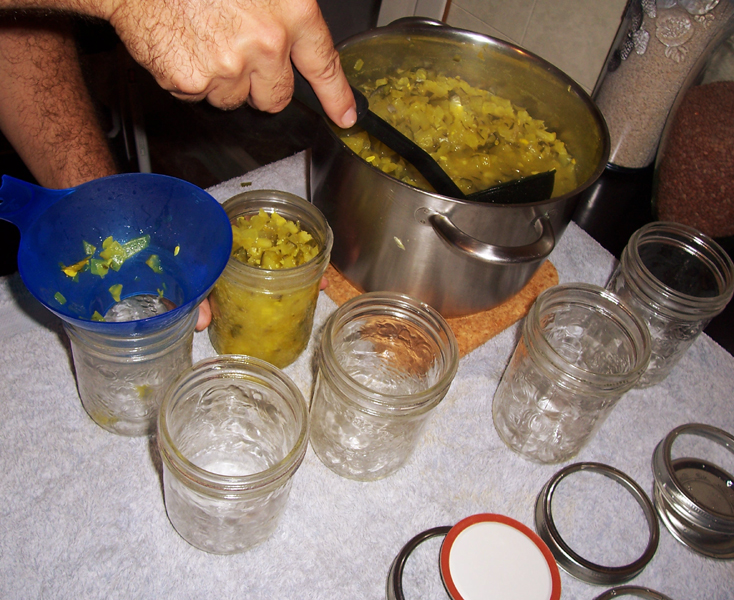
Stand by for action.

Krista joined me during the cooking phase and our teamwork made the task of jarring the relish smoother. Plus, we like dancing in the kitchen.

Combien?

We sterilized six jars thinking that would be enough, but we put in two more at the last minute. The initial recipe said it would yield 16 half pint jars, but I increased the quantity of ingredients to use up as many cucumbers as possible (believe it or not, I managed to use up only six of them!).

Seven jars a-boiling.

We filled eight 500mL jars in the end (4L total), but only vacuum-preserved seven (the last one will have been eaten by us by the time you've finished reading this).

Yum.

As the jars cooled, they gave a distinctive and satisfying "pop" as each lid announced the seal was formed well and that that jar of relish would last for a year (or more!) in a cool, dark place.

So there it is. I wish you could taste it. In fact, I haven't tasted it myself just yet, since it's still hot; I'll have to wait until tomorrow morning.

The Small Pond Arts Canning Adventure (to use up all them damned cucumbers) will continue with Bread & Butter Pickles this weekend...

UPDATES:

21 August 2011:
Seven 500mL jars of Bread & Butter Pickles
(pearl onions: yes; cauliflower: no)

26 August 2011:
Seven 1L jars of Garlic Dill Pickles


04 September 2011:
(Twelve of) Thirteen 500mL jars
of Bread & Butter Pickles

(pearl onions: yes; cauliflower: no)


12 September 2011:
(bottom right) Six 1L jars
of Bread & Butter Pickles

(pearl onions: yes; cauliflower: no)
Location: The Pickle Cave